Welcome & Introduction to 2013 Growing Season

Hi! Welcome to the 2013 growing season. My name is John Costa. I will work at Radix Farm once a week this year. I am coming into farming as a second career. My passion about growing food stems (no pun intended) from an interest in revitalizing the small farm sector while building resiliency and redundancy in our food system by developing a robust local food economy.

The connection to Radix was made through the CASA Future Harvest Beginning Farmers Training Program, which pairs a beginning farmer like myself with an experienced farmer of Kristin’s caliber. She will be my mentor. I will work with her “shoulder-to-shoulder” to learn how to grow commercially through application, dialogue, and research.

Growing up, I would help my parents and grandparents grow fruits and vegetables in our backyard. They grew crops they missed from our native Bangladesh. My favorite part was watering the plants every evening so that we would have fresh tomatoes, cilantro, squash, chili peppers, and leafy greens. There is nothing like tasting fresh picked vegetables and herbs and having them for dinner. The smell and taste are unparalleled. That is what draws me back to the land to become a farmer.

My aspiration is to grow intensively year-round on a couple of acres. This past fall and winter, as an apprentice at ECO City Farms (located in Edmonston, MD), I had an opportunity to observe and learn through application how to manage a small-scale intensive farming operation. The variety of crops that you can grow as the temperature drops close to freezing and daylight hours dwindle to less than 10 hours a day blew my mind. At Radix, I will see how to grow in a semi-rural setting at the other end of small-scale agriculture operation.

I am really excited to grow some of the produce you will be eating this year. Looking forward to meeting you when you come to pick up your produce at our farm stand this year. Until then, be merry and be well.

- John

Subsidized CSA Shares Now Available

Thanks to a generous contribution from the Brighter Days Collective, Radix Farm is now offering subsidized half-price shares to qualifying low-income households.  We’re excited to extend the opportunity for folks to join who might not normally join a CSA and find it difficult to afford a full-price share.   Healthy, fresh, and local food for all is such a vital part of the movement for food justice and sustainability.  Thanks Brighter Days!!

Subsidized CSA shares are the same size as full-price shares and include all the same benefits as full-price membership; there will be no distinction once you become a member of the Farm.  Subsidized memberships are available at our Regular CSA pick up and at the Market CSA pick-ups (Market CSA at the $600 level ONLY).  There are a limited number of subsidized shares available, and they will be filled in the order in which we receive applications.  Please see the CSA Information page for details on the CSA options and instructions on how to join.  If you think you qualify for the low-income share, please check the chart below and then email us at radixfarm(at)gmail.com.

Regular CSA:   Full-price = $675.  Subsidized shares at half-price = $337
Market CSA:
 Full-price = $600.  Subsidized shares at half-price = $300, (you will receive $630 in your farm debit account).

Anyone who qualifies for government assistance (WIC, EBT, or disability) is welcome to apply for a subsidized CSA share.  You are also eligible for a subsidized share if your total household income is equal to or below the amount indicated in the chart below. The definition of household is all the persons living with you with whom you share food.

Total number of people in your household Combined income, less than
1 $20,665
2 $27,991
3 $35,317
4 $42,643
5 $49,969
6 $57,295
7 $64,621
8 $71,947

Now Accepting Applications for 2013 CSA Membership

Join Radix Farm for the   DSCN0874

2013 CSA Season

We are now accepting new members for the 2013 season.  Folks interested in becoming new members should fill out this 2013 Radix Farm CSA Membership Application (click to access form).   We will accept new members in the order in which we receive applications.  We will respond via email to let you know if  your preferred pick-up site is available. If  you are accepted, we’ll email you the complete Member Information Packet and Member Agreement.  You’ll have seven days to mail your payment and signed copy of the Member Agreement and secure your slot in the CSA.

2013 CSA Options

Radix Farm offers two distinct types of CSA pick-ups.  When you fill out your Membership Application, you must indicate  your preferred pick-up type and site from the list below.  Complete details on the CSA, membership, what is in a share, and more are available in the CSA INFORMATION tab above.

REGULAR CSA PICK UP
Traditional-type CSA wherein the Farm determines what members receive each week and distributes the share at a designated pick-up site.
Pick Up at St. Stephen’s Church
1525 Newton St., NW (at 16th St)
Tuesdays, 5:30pm – 7:00pm
22 weekly deliveries, late May – early November
$675 per share

MARKET CSA PICK UP 
Members join and pay upfront into a debit account, then shop at the the Radix Farm stand at one of our farmers markets, choosing what you want each week from what is available and your account is debited.

Pick Up at Petworth Community Market 
On 9th St., NW, at Georgia Ave (between Upshur St. and Taylor St.), DC
Fridays, 4:00pm – 8:00pm
May  - October
$425 or $600, (plus 6% or 10% bonus added to debit account)

Pick Up at  Ballston Farmers Market 
Welburn Square, 901 North Taylor St., Arlington, VA
Thursdays, 3:00pm – 7:00pm
May 2 – October 31
$425 or $600, (plus 6% or 10% bonus added to debit account)

 We hope you’ll join us for the 2013 season!!   

2013 Job Opportunities

Job Opportunities on Radix Farm!

January already.  It’s time to shift into major planning mode.  A big part of planning for a successful season is finding excellent farmhands to help get the job done.  Radix Farm is looking for a full-time Farm Assistant and a few part-time Interns for the 2013 season.  Please spread the word!  Both positions offer the opportunity to learn the ins and outs of running a small-scale sustainable farm operation.  Please see  the Job Opportunities tab for more information on qualifications and responsibilities.   We’re accepting applications now.

working

Food Mythbusting Video feat. Radix Farm

Hurricane Sandy is in our midst. Rain is pouring down, the wind is picking up, and poor Punky the farm puppy is scared (though not Sprout “tough as nails” farm dog).   I did what I could to prepare the farm – battened down, stored supplies in the barn, harvested all the sweet potatoes.  Now we just wait and hope that we stay safe and that there will be a few veggies left to harvest at the end of the week.  At least Sandy gives me the perfect opportunity to catch up on blog posts and office work (until the power goes out that is).

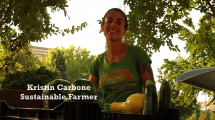
Without further ado, here is the great unveiling of Radix Farm’s Food Hero video.  Click on image below to watch video.

Released as part of a Food Mythbusters campaign by Real Food Media Project, Radix Farm’s Food Hero video accompanies an animated short  that takes on the myth that we need industrial agriculture to feed the world. Food Mythbusters is  a collaborative initiative to inspire, educate, and grow the movement for sustainable food and farming across the United States. Major project partners include Anna Lappe (Diet for a Hot Planet), Free Range Studios (of Meatrix fame), and Corporate Accountability International.

I had the pleasure of speaking with Anna Lappe at the recent Real Food Hopkins 100-mile meal in Baltimore.  Students in the Johns Hopkins chapter of Real Food Challenge  organized a Food Day Celebratory screening of the Food Mythbusters video and Farmer Hero video and served a delicious meal all sourced from within 100 miles.

In separate news, this weekend Slow Food DC awarded Radix Farm the Snail of Approval award. The Snail of Approval recognizes those eateries and artisans who contribute to the Quality, Authenticity and Sustainability of the food we eat in the Washington, DC metro area.  Thanks Slow Food!!  And congratulations to all the other 2012 award winners.

Wishing everyone a safe week ahead.

- Farmer Kristin

Fall comes to Radix

Post from farmhand Kelly. You can find more photos of fall at the farm on Facebook, here.

Fall is here.  You’ve seen it as kids head back to school, temperatures drop into the oh-so-cool 60s and 70s, and the leaves just barely start to change their color.  At the farm, we’re grateful for the cooler temperatures, the subsequent die-off of certain pests, and the abundance of new crops to harvest.

This slideshow requires JavaScript.

We have greens again at long last, in more varieties and flavors than we can sometimes remember: mixed greens, arugula, head lettuce, radicchio, endive, senposai, Chinese thick stem, tat soi, bok choy, broccoli raab, kale (4 varieties!), collards… I hope I’m not forgetting any of our beloved greens.  We also again have beets, hakurei turnips, purple top turnips, and radishes and broccoli will be ready soon.  We’ve harvested all our winter squash, and are in the midst of getting through 600 row feet of sweet potatoes.  Let us know if you want to volunteer, wink, wink.  We’re enjoying the last of the tomatoes, eggplants, peppers, and herbs that are still kicking around, and will soon harvest the ginger that has been growing all year in (what was) the greenhouse.

As some of you may know (and gotten to enjoy), more and more of the chickens are laying these days.  We’ve also been surprised to learn that one of the flock of presumed hens is actually a rooster.  He’s just begun to learn how to cock-a-doodle-doo, much to our chagrin.  We also have a few new specialty crops this year along with the ginger: cardoon which we are currently blanching (like artichoke, we are told), and hops, which we are currently drying as we prepare to find someone to brew the first Radix Ale :)

Fall has also brought new visitors and residents to the farm.  Punky, the adorable new farm puppy (to be promoted to farm dog at a later date), joined our ranks in August and has been doing her part harvesting sweet potatoes and generally being cute around the farm.  We enjoyed a strange and prolonged visit from Homer the homing pigeon in August as well, though he has since flown on, presumably to his..er… home.  Our most recent visitors were interns and staff from Arcadia Farms who helped us for a morning and checked out our operations.. thanks again!

Now we’re doing the good work of preparing for the winter; putting away tools and irrigation lines, seeding cover crop, and planting things to overwinter like garlic and 400 new row feet of strawberries.  It’s been a great, if tough, season, and we’re excited to share a bountiful fall harvest with you all!

Reflections on the Storm

I started working as an intern at Radix farm almost two months ago, and have already begun to develop the cracked and permanently dirty hands to show for it. While farming has meant much more physical work than my old desk job, this new step has felt like a pretty natural shift from my previous tenure as a climate change organizer, and I’ll explain why.  Prior to starting at the farm, I helped start and worked for almost five years at 350.org, an international organization working to build a movement to fight climate change.  More recently, I wanted to see what it felt like to work more in depth at a more local scale, and learn how successful local solutions like CSA’s really work.  To me, working on one small piece of land to feed 50+ families is as local and in-depth as I could imagine.

Two weeks ago, as I watched the wind rip trees down in the street before me, and heard reports of the damage at the farm (see Facebook for photos and details of the damage), I was newly aware of just how connected my work on climate change is to work on the farm. My last project at 350 was “Connect the Dots“, an initiative with the goal of making the connection between the extreme weather we’re already witnessing, and climate change, undeniable.   The connections are not always simple to explain scientifically, but all of us, especially the older amongst us, feel it: the weather is different.  And the scientific evidence that the increasing severity and frequency of certain weather phenomena is linked to climate change is strong and increasing (for some simplified, but well cited fact sheets and materials created by yours truly, click here).  Scientists and meteorologists are already weighing in about the connection between Friday’s rare “derecho” storm and climate change, saying it is very clear that the extreme heat wave scorching the country accounted for at least some of the storm’s severity.  The connection between increasingly frequent and severe heat waves and climate change is well documented by some of the most widely respected scientists doing this work.

While focusing in at the local level has felt very rewarding, seeing the damage of Friday’s severe storm was a stark reminder to me of the importance of seeing the big picture.  Farmers are used to being at the whim of the weather, but there are simply some changes you can’t adapt to, and a frequency at which losses and damage are too great to recover from.  I believe we have to say “yes” to beautiful and important solutions like CSAs and small sustainable farms, but also “no” to problems like fracking, mountaintop removal mining, and industrial agriculture – or the solutions we’re working so hard to create won’t even be viable in the face of increasingly severe weather as climate change intensifies. So, as we enjoy this week’s produce, I hope everyone will consider the bigger picture of how our actions affect the world around us and what else we can do to ensure sustainable agriculture’s future and our own futures.  (oh, and also consider how we might rebuild that greenhouse!).

Thanks,

Kelly

Image